Property Management Platform
Designed a role-based SaaS platform serving six user types across two markets. Built complex operational dashboards, data-intensive workflows, and a scalable design system from scratch.
Role
Senior Product Designer
Industry
Real Estate
Duration
6 months

Project Overview
Home Trumpeters is a property management SaaS platform built for multiple user types operating inside one shared system. Property owners, tenants, administrators, vendors, field staff, and service providers all use the same platform but need completely different things from it.
I was brought in as the lead designer on a product that did not exist before I joined. No existing design system, no established patterns, no prior designer.
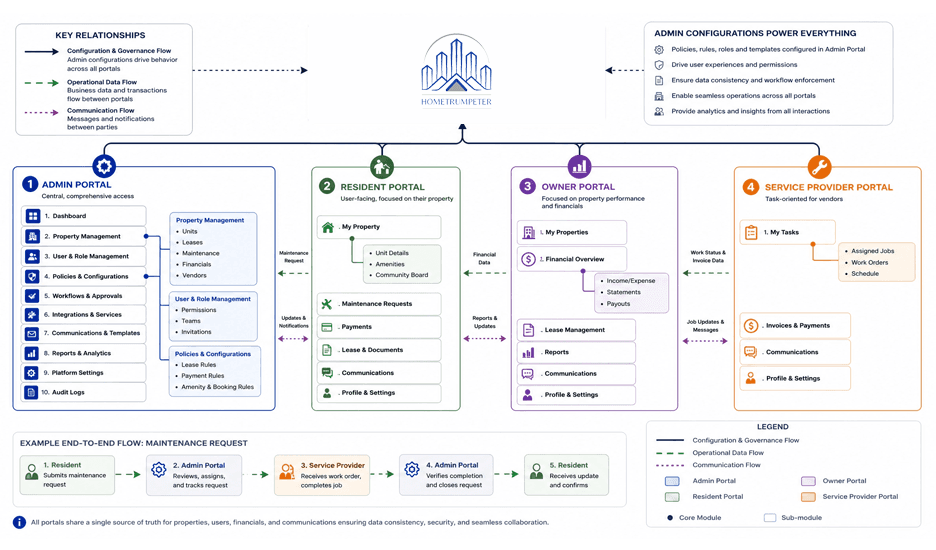
The platform architecture showing role-based portals connected through a shared data layer. Admin configurations govern all downstream portal experiences. Three distinct data flows, governance, operational, and communication, ensure consistency across all user types
Business Context + Problem Statement
Property management across North American and African markets runs on workarounds. Owners use spreadsheets. Tenants chase requests by text. Service providers get jobs through phone calls. There was no single platform holding all of it together.
The client needed one SaaS product that could handle operational workflows, financial management, maintenance coordination, analytics, AI-powered risk insights, and role-based permissions, all within one coherent system. The complexity was real: every user group interacted with the same underlying data but needed a completely different view of it.
The risk was building something that tried to serve everyone and ended up serving no one well.
Research + Discovery
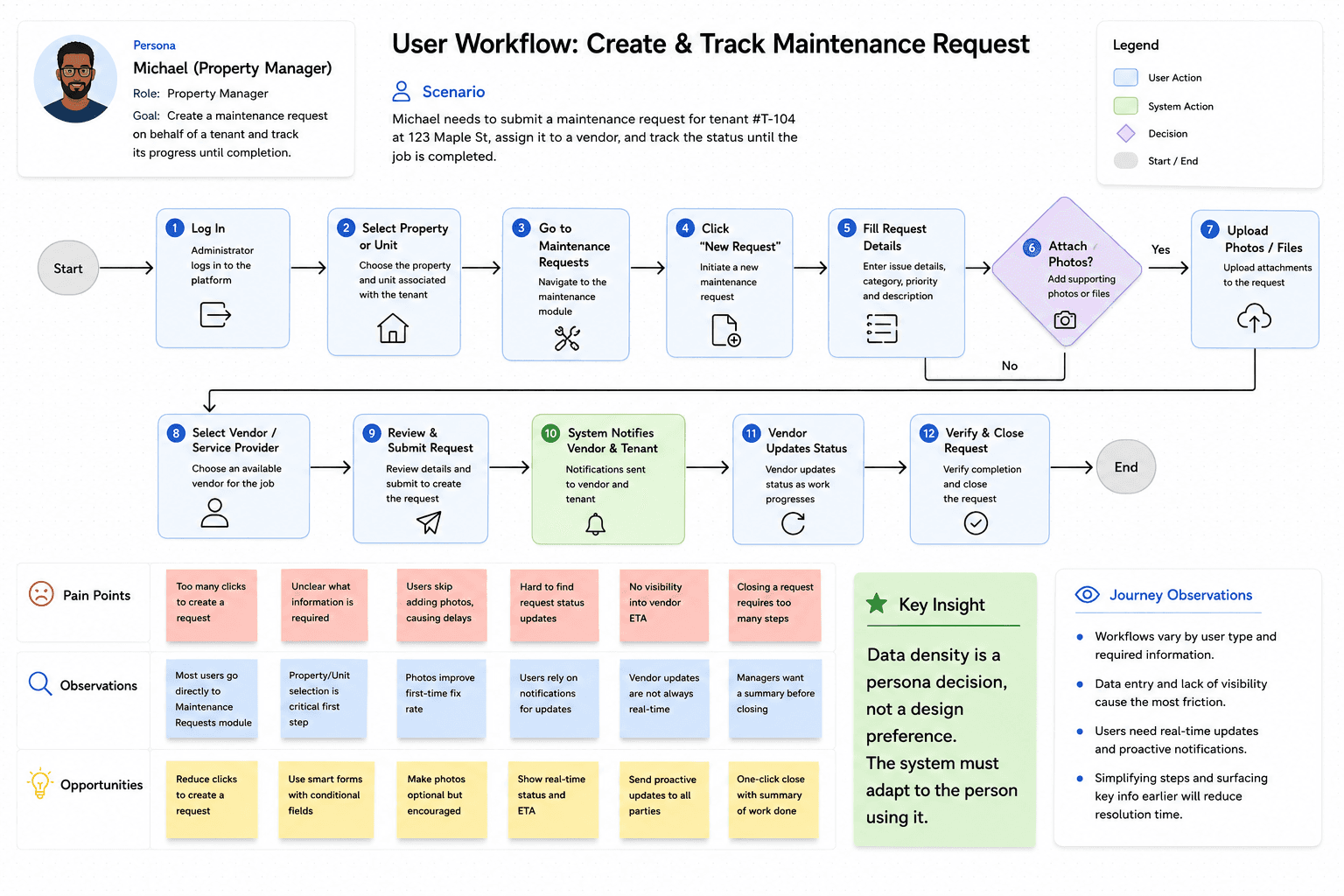
I worked closely with founders and product stakeholders to map operational workflows for each persona before designing anything. Stakeholder interviews, role definition sessions, and journey mapping across all six user types.
What the journey mapping exposed was the scale of the difference between personas. An administrator needed to see everything: transactions, user permissions, service requests, financial summaries, all at once. A tenant needed to see almost nothing: their unit, their requests, their payments. An owner needed a clear financial picture without the operational density that would overwhelm them.
The insight that shaped everything: data density is a persona decision, not a design preference. The same information architecture cannot serve all six users. The system needed to adapt to the person using it, not the other way around.
Strategic Opportunity + Design Challenge
The easy answer was building separate products for each user type. That was also the wrong answer. It would have created maintenance complexity for engineering, inconsistency across the platform, and a system that could not scale.
Three things shaped the design direction:
One system, six experiences. The platform needed a shared design language that could adapt contextually to each persona without fragmenting into separate products.
Density without overload. Admins needed everything visible. Owners needed clarity. Tenants needed simplicity. Designing for all three from one component library required building flexibility into the information architecture from day one.
AI that helps without overwhelming. The platform included AI-powered risk advisory tools for fintech integrations. The users acting on those alerts were not financial analysts. The design had to surface useful intelligence without exposing raw data people could not act on.
Design Approach + Leadership & Collaboration
As the sole designer on this engagement, I owned the project end-to-end. Discovery, information architecture, interaction design, component system, and production handoff across all screens.
I designed a role-based experience framework where each persona sees the platform shaped around their actual job. Navigation adapted to the user's role. Dashboards prioritized role-specific actions. Permissions shaped what was visible dynamically. The visual language stayed consistent across all of it.
Working closely with two developers and a product manager, I delivered wireframes, prototypes, and production-ready Figma files at every stage. I used Claude and UX Pilot throughout to pressure-test edge cases and move from rough ideas to stakeholder-ready work faster.
The question I kept coming back to at every decision point: does this screen show the right person the right information without making them wade through everything else?
Solution + Design System
The role-based navigation was the core of the solution. Each persona's view of the platform was shaped around their actual responsibilities. Admins got density. Owners got clarity. Tenants saw only what was relevant to them. Badge counters surfaced pending work without interrupting current flow. One consistent status badge system ran across all screens so the visual language held regardless of which persona was using the platform.
The admin dashboard surfaced real-time revenue analytics, user distribution across roles, transaction histories, and live notification feeds in a single operational view, giving administrators complete platform visibility without switching screens.
For executives and administrators, I designed KPI dashboards and data-dense analytics views where visual hierarchy was the only thing standing between the user and information overload. Per-property financial summaries, transaction histories, and occupancy pipelines all visible without opening nested views.
For the AI-powered risk advisory tools, the design showed three things: what the risk flag was, why it mattered in plain language, and what to do about it. No raw data dumps, no technical explanations. Just enough to make a confident decision and move forward. Fail-safe retry states handled the moments when fintech integrations timed out or returned incomplete results, keeping users in control even when the system failed.
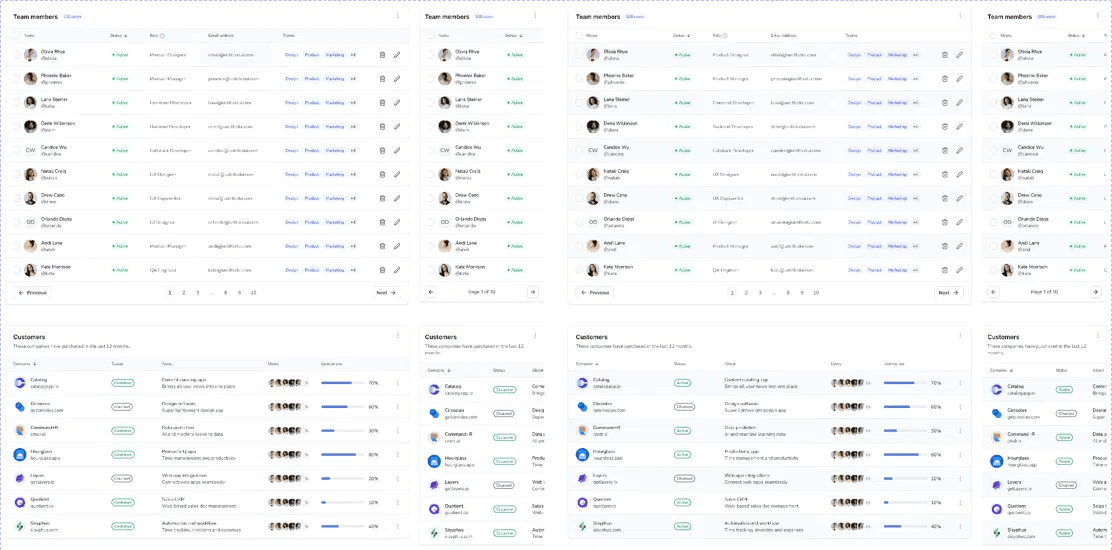
The design system was built with Figma variables, design tokens, and Auto Layout from day one. The system gave the development team precise component specifications and enabled them to build with confidence across the full platform.
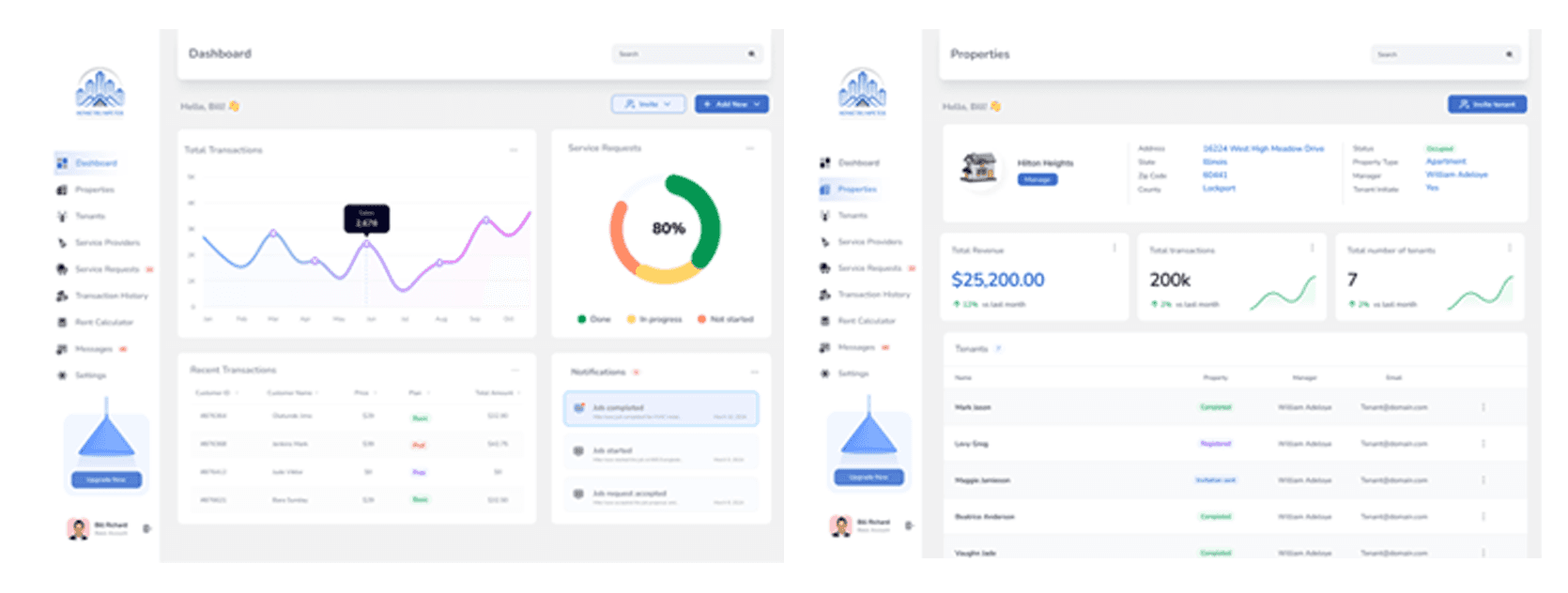
Admin operational dashboard showing real-time revenue analytics, user distribution across managers, owners and providers, recent transaction history, and live notification feed. Badge counters on navigation surface pending work without disrupting current flow.
Impact + Key Learnings
Delivering a complete role-based platform across six user types in six months on a product that did not exist before I joined required making a lot of decisions fast. The role-based architecture held up through development because the design system gave engineering a consistent foundation to build from. Components did not need to be rebuilt for each persona. They adapted.
Three things I take from this engagement.
Data density is a product decision, not a preference. Administrators needed everything visible at once. Owners needed a clear financial picture. Tenants needed to see almost nothing. Designing for all three from one component library meant building flexibility into the information architecture from day one, not adding it later.
AI features need fail-safe states more than they need confidence. The risk advisory tools were only useful if users trusted them enough to act on them. That trust came from showing what the system was recommending, why it mattered in plain language, and what to do about it. When the integrations timed out or returned incomplete results, the fail-safe states kept users in control instead of leaving them stranded.
Build the system before the features. Every screen that came after was faster to design, easier to hand off, and more consistent because the foundation existed before the product did. That investment paid back across every component, every persona, every screen.
Other projects

Healthcare Benefits Enrollment Platform
14 million people make healthcare decisions on this platform every year. Most were completing enrollment without understanding what they had chosen. Redesigned the entire experience from research through design system to fix that.

Multi-Brand Ecommerce Platform
Designing a scalable ecommerce platform that businesses could use to launch branded online stores without rebuilding the shopping experience from scratch.
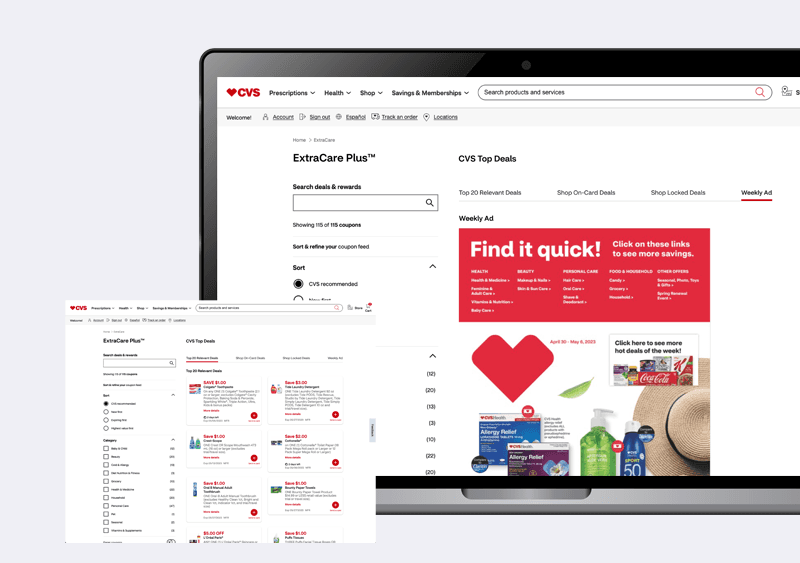
CVS ExtraCare Plus Deals Redesign
Redesigned the CVS ExtraCare Plus deals experience to make coupon discovery faster, filtering clearer, and the foundation scalable for future growth.

College Aid Pro
Completion time down 60%. Submission rates up 45%. Support contacts down 80%. The numbers came from fixing one thing: users never knew where they were or what came next.